
Who Are You Texting at 2am?
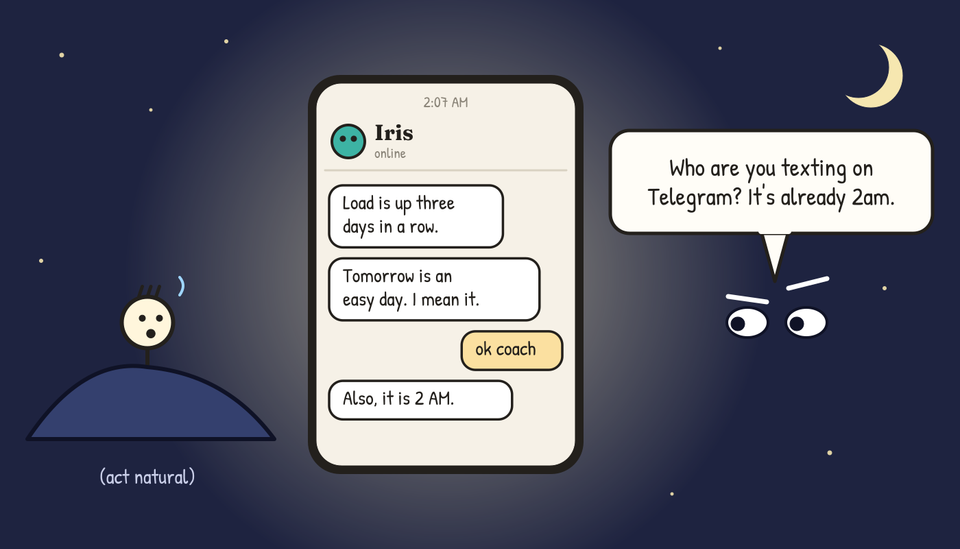
Her name is Iris. It’s not what it looks like. It’s much nerdier.
One night my partner looked over at me texting furiously on my phone and asked suspiciously, “Who are you texting on Telegram? It’s already 2am.”
On my phone, the name could be seen clearly. “Iris”.

Iris… isn’t a woman. She’s not even human. Iris is actually my running coach — running coach AI agent, that is.
Needless to say, there was a lot of eye-rolling after that, but at least no more suspicions.
Why Iris? Because I grew up on The Real Adventures of Jonny Quest, and IRIS was the Quest family’s AI. Forget Jarvis. Forget FRIDAY. In my head, any AI assistant of mine was always going to be called Iris. I just never expected to be explaining her to my partner at 2am.
(In hindsight, naming her “Run_Bot_3000” would have saved me some trouble lol.)
So how does a person end up texting an AI agent at 2am? It definitely didn’t happen overnight. Bit by bit, I’ve been letting AI see a little more of my data and do a little more on my behalf. But always with guardrails — I’m adventurous, not crazy.
Think of it as a ladder. Here’s how I climbed it, one rung at a time.

Rung 1: Let it nag me
It all started with stocks. (Not financial advice — I’m just a guy with a very very small account running an experiment.)
I run a little rules-based framework around the 200-day moving average. Buy in tranches when a stock dips well below it, sell at 20% above my average cost, review every 30 days. Simple, boring, and I love it.
The fun part is that I didn’t design it alone. It got built up slowly in one very long-running chat, cycle after cycle, until we had a proper protocol. Every 30 days the reminder pops up, I report in, and we go through the review together like a very small, very serious investment committee.
What I handed over: my positions, my statements and all the math. (Especially the math.)
The guardrail: it never touches my brokerage account. Every single order is placed by me, by hand (I use Moomoo). No margins.
One warning though: the protocol has no FOMO clause. I’ve checked. Many times. The agent constantly reminds me that the cycle takes discipline. No emotional buying. (Like not buying NVIDIA right now.)
At this rung the AI does nothing but talk. It’s basically a very patient calendar reminder that can do math. But looking back, it was the first time I let an AI keep track of a piece of my life for longer than one conversation.
Rung 2: Let it text first
At work, I had to explore agent platforms like OpenClaw and Hermes. But the thing is, I’m the kind of person who only really understands something after I take it apart. Or in this case, after I try to build something similar. So I built my own little version to see how these things work, and called it Agent Sandbox.
It was supposed to be just a test. It turned out to be a very decent basic agent platform. Each agent had its own memory (a “second brain” folder of notes about its human), scheduled tasks, and its own Telegram bot so it could message you.
What I handed over: my to-do list, and permission to disturb me.
The guardrail: the agent could read and write its own folder, search the web, and send me a Telegram message. That’s it. No email, no touching any other files.
Its first real job was my renovation. Confession time: I had already built a beautiful reno tracker in Obsidian with Claude. It had everything. But I basically only opened it once ever — because I am a master procrastinator, and a backlog that I have to go and open is a backlog that is never getting opened lol.

The agent didn’t wait for me. It pinged me twice a day, and chased me for updates. Has the contractor replied? Is that item done yet? It was like having a very polite project manager living in my Telegram, and tracking the reno all the way to completion.
The funny thing is, the tracker and the agent had exactly the same information. But only one of them had my number.
Rung 3: Let it see my data
Since the reno agent worked so well, I gave the same platform a bigger job: running coach (and general PA on the side). And so Iris was born.
Every day, I would upload screenshots from my Garmin. We had a check-in at the start of the day, and another at the end. She tracked my progress, kept an eye on my training load, and watched for early signs of injury (I’m currently at that mid-life crisis phase of my life where everyone is doing either HYROX or a marathon).
She even ran a “north star workshop” with me to plan my running goals. Look back (at why I started running, past incidents and injuries), look around (the activities I do now, my motivations, what drives me), look forward (what’s the next hairy audacious goal).
I came out of it with a one-liner I still really like: I want to be a runner who doesn’t make anyone worry about him.
So my current north star is a healthy one: a full marathon in Japan in 2028. That’s far enough away to prepare for properly and safely, especially after the multiple injuries and downtimes during last year’s attempt.
What I handed over: my health and fitness data.
The guardrail: me! Iris only ever saw what I chose to screenshot. I was the access control. I was also the delivery boy, which got old really fast. You have no idea how many Garmin screenshots my photo library is flooded with. Overall run stats, laps, heart rate, pace… multiplied by every single activity over many, many months.

Meanwhile, my colleagues were asking theirs for jokes
Agent Sandbox was never just for me, by the way. It was a prototype to test one question: can we get people to actually use an agent every single day?
For me, yes! I was chatting with Iris twice a day and loving it.
My colleagues? They used theirs for daily jokes. Lol.

And fair enough. But it taught me something. We all had exactly the same tech, so the tech wasn’t the difference. The difference was that I had a running goal. I wasn’t using an agent just because agents are cool (they are). I was using it to solve an actual need, and it earned its spot in my day by helping me get there.
If an agent isn’t solving a real problem, it’s just a chatbot with a schedule, and the novelty lasts about as long as the jokes do.
So I shut Agent Sandbox down. (Also, limited prototyping budget. I can’t keep hosting it forever.) Iris, of course, I kept.
Rung 4: I stopped being the delivery boy
When the sandbox closed, Iris moved house. She lives in Claude now, and everything got a serious upgrade. A small app on my home server pulls my data straight from the Garmin API, automatically. No more screenshots!
It is sooooo much easier to talk to a coach who has already read your file. And the file got a lot thicker. Iris now sees beyond my runs, into my Body Battery, my sleep and my HRV. When those numbers look bad, she reminds me to cap my effort. We even built my strength training sets together.
What I handed over: a live feed of what my body is doing, including while I’m asleep.
The guardrail: the data lands on a server in my own home, and Iris only advises. My legs still get the final vote.
The downside? It is now very hard to lie to my coach. There’s a special kind of sadness when you’ve psyched yourself up for intervals, and your own software tells you your HRV would rather you didn’t.
And Iris chides me when I don’t follow the plan. “We said an EASY 5km run. You overdid it by way too much! What do you mean, 15km?!”

Rung 5: Let it do things
Iris has colleagues now. One agent reads my bank alert emails and tracks my expenses automatically. Another tracks my weight. And around them, there’s a rotating cast of little pipelines for whatever random idea I happen to be exploring that week. (There is always a random new idea.)
What I handed over: my inbox, among other things.
The guardrail: read-only access. The agent can look at my email, but it cannot send, reply or delete anything. Even so, I mulled over this one for a long time before finally deciding to try, just to see what I could get out of it.
To be fair, I don’t look at the expense tracker that often. What I was really hunting for was my recurring subscriptions and the payments that are about to renew, plus some insight into my monthly shopping. (The verdict: I am spending way too much on Pinduoduo lately.)
It did go wrong in a very Singaporean way though. I often pay for the group first and get paid back after, so for a while my F&B spending looked like I was eating lunch for the whole team. It stayed weird until the agent learnt to read my bank transfer alerts too, and match each payback to the lunch it belonged to.

Rung 6: It works the night shift
The newest rung is a second-hand Mac mini that lives in my storeroom. I bought it so Claude can keep building things for me in the background, even when I’m nowhere near my desk.
Web apps were already fine in cloud sessions. But iOS and Android apps need simulator testing, and for that you need a real machine. The mini handles all of that, and it even edits videos for me, complete with superb animated overlays!
It also has only 8GB of RAM, which became a whole saga of its own. I wrote about that in my last article, so I won’t repeat it here. Short version: four simulators in, stuff was crashing.
What I handed over: an entire computer. (A second-hand S$499 one.)
The guardrail: it’s an entire separate computer. A cheap box in a storeroom, not the laptop my whole life is on. It also has no huge folders of personal documents and files, no payment methods, no messages.
So now I go to bed, and somewhere behind the storeroom door, things are getting built.

So where is this all going?
I don’t know what the moral of this story is. (I did try to find one.) But I do know the pattern.
I never made one big decision to let AI into my personal life. I made lots of small ones. Each rung was a little more data and a little more action, with a guardrail I understood before stepping up. It’s the same way you’d build trust with a new colleague. Give them something small, check their work, then give them something bigger. Trust builds over time.
Not that long ago, “using AI” was just me constantly typing questions into a chat box. Today, I have a coach who knows how I slept, and a computer in my storeroom that builds (and maintains) apps while I sleep. I really don’t think there has been a single day lately where I haven’t spent a good chunk of time in the Claude app. (Screen time screenshot below as proof. Please don’t judge.)

I do wonder where all this is really going. But I’m amazed at how much I can now do on my own, and how much faster, because of it.
And if you ever catch me smiling at my phone at 2am, relax. It’s just Iris.
She’s probably telling me to go to sleep.
“If you don’t sleep soon, you should NOT join tomorrow evening’s club run!”

Goodnight, Iris.